Disclosure: This post contains affiliate links. If you buy through them, THE GILT may earn a commission at no extra cost to you. We only recommend products that meet our evidence and usefulness standards.
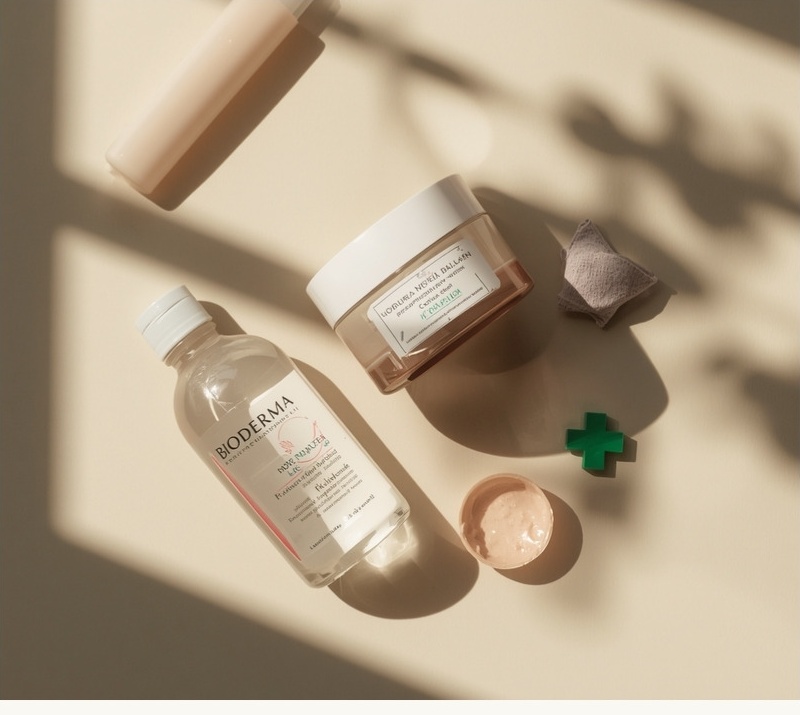
Walk into a French pharmacy and you will not find a beauty counter. You will find a green neon cross, a pharmacist in a white coat, and shelves of unglamorous tubes that hold some of the best skincare in the world — most of it under €20.
This guide gives you the nine products actually worth your money in 2026, what each one costs, and — because you deserve more than a shopping list — the three myths the science does not support.
Key takeaways
- If you buy one thing: Bioderma Sensibio H2O micellar water
- The one with the strongest evidence: daily sunscreen — La Roche-Posay Anthelios
- A313 is a gentle retinoid, not a prescription in a chicer tube
- The whole point is fewer products, used consistently — not a 12-step haul
Why French pharmacy skincare works
French pharmacy skincare (parapharmacie) runs on a logic opposite to most of the beauty industry. It is dermatology-led, not marketing-led. Short formulas. Forgettable packaging. Almost suspiciously low prices.
The philosophy is restraint: a small number of well-chosen products, used consistently, with the skin barrier treated as something to protect — not scrub into submission.
The French do not have better genes. They have a better default: fewer products, used for longer, chosen for the barrier rather than the bathroom shelf.
1. Bioderma Sensibio H2O — the micellar water
If you buy one thing, buy this. Bioderma Sensibio H2O is the product that taught the world what micellar water was: a no-rinse cleanser that lifts makeup without stripping skin. Clinical work published in the Journal of the American Academy of Dermatology found micellar formulas well tolerated even on sensitive skin.
Best for: everyone, especially sensitive skin
Price range: ~€12–15 for 500 ml
2. La Roche-Posay Anthelios — the sunscreen with real evidence
Here the science is unambiguous. A randomized controlled trial in the Annals of Internal Medicine found daily sunscreen measurably slowed visible skin aging. Anthelios is the line worth knowing: high protection, elegant textures, kind to reactive skin.
Best for: the one non-negotiable step
Price range: ~€15–25
Shop La Roche-Posay Anthelios →
3. Embryolisse Lait-Crème Concentré — the makeup artists’ moisturizer
Embryolisse has lived in professional makeup kits for generations because it triples as moisturizer, primer, and calming mask. One product, earning its place three ways.
Best for: normal to dry skin, makeup days
Price range: ~€13–18
Shop Embryolisse Lait-Crème Concentré →
4. La Roche-Posay Cicaplast Baume B5 — the repair balm
For skin that’s irritated, healing, or simply overworked, Cicaplast Baume B5 is what dermatologists reach for: niacinamide and panthenol built to calm a compromised barrier.
Best for: retinoid irritation, winter skin, post-procedure
Price range: ~€8–12
5. A313 Pommade — the viral one, viewed calmly
A313, the vitamin-A ointment on its fourth internet moment, deserves a calmer look than the algorithm gives it. Its active is retinyl palmitate — the gentlest (and, per a review in Clinical Interventions in Aging, the weakest) member of the retinoid family. A lovely, low-irritation introduction to vitamin A. Not a prescription retinoid in a chicer tube.
Best for: retinoid beginners, sensitive skin
Price range: ~€8–12
6. Nuxe Huile Prodigieuse — the sanctioned indulgence
Restraint doesn’t mean joylessness. Huile Prodigieuse is the rare pharmacy product that feels like luxury — a scent people stop you to ask about, on a dry body oil that costs less than lunch. Every disciplined routine is allowed one pleasure. This is it.
Best for: body, hair ends, the smell of a French summer
Price range: ~€20–30
7. Avène Thermal Spring Water — the comfort, not the cure
Avène’s thermal water spray is genuinely soothing on reactive, post-sun, or freshly exfoliated skin. Know what you’re buying: a comfort with a long safety record, not an active treatment.
Best for: redness, travel, resetting angry skin
Price range: ~€8–14
Shop Avène Thermal Spring Water →
8. Homeoplasmine — the backstage lip secret
A humble multi-purpose balm that became a backstage legend. Makeup artists use Homeoplasmine to prep lips before matte lipstick and to calm chapped anything. One tube lasts a year.
Best for: lips, cuticles, windburn
Price range: ~€6–9
9. Klorane Oat Dry Shampoo — the hair one worth the shelf space
The dry shampoo French pharmacists have recommended for decades: Klorane’s oat milk formula absorbs oil without the chalky cast or the perfume cloud. It’s the quiet standard newer brands get compared to.
Best for: second-day hair, travel
Price range: ~€9–13
Shop Klorane Oat Dry Shampoo →
A simple French pharmacy skincare routine
Five steps, two of them optional:
- Morning: rinse with water → moisturizer (Embryolisse) → sunscreen (Anthelios)
- Evening: micellar water (Sensibio) → rinse → A313 two to three nights a week → moisturizer
- When irritated: skip the actives, Cicaplast until calm
- Optional comfort: Avène spray after sun or exfoliation
- Optional pleasure: Nuxe oil on body and hair ends
3 French pharmacy myths the science does not support
Myth 1: “French” on the label means better skincare
Most moisturizers — luxury, pharmacy, or drugstore — are built from the same three ingredient families: humectants, emollients, occlusives. Formulation quality matters; country of origin does not. “French” is a useful heuristic, not an ingredient.
Myth 2: Micellar water means never rinsing again
“No-rinse” is a marketing decision, not a dermatological one. Several dermatologists suggest rinsing after if your skin is reactive or you layer retinoids on top. Excellent as a first cleanse. Incomplete as your entire philosophy.
Myth 3: The dermatologist brands are beyond question
In 2025, La Roche-Posay’s Effaclar Duo was voluntarily recalled in the US after FDA testing found elevated benzene in some benzoyl peroxide products. The risk was very low and the vast majority of tested products were clean. Practical takeaway: buy benzoyl peroxide fresh, store it cool, replace yearly — and keep your skepticism evenly distributed.
FAQ: French pharmacy skincare
What should I buy at a French pharmacy?
Start with the top four: Bioderma Sensibio H2O, a La Roche-Posay Anthelios sunscreen, Embryolisse Lait-Crème Concentré, and Cicaplast Baume B5. Together they cover cleansing, moisture, repair, and sun protection for under €60.
What is the French skincare routine?
Minimalism, applied daily: gentle cleanse, moisturize, sunscreen every morning, one active (such as a retinoid) a few nights a week. Fewer products used consistently beat elaborate routines used sporadically.
Is French pharmacy skincare cheaper in France?
Usually 30–50% cheaper than the same products abroad, which is why they remain the classic Paris souvenir.
Sources
- Micellar water tolerance — Journal of the American Academy of Dermatology
- Hughes et al., Sunscreen and Prevention of Skin Aging — Annals of Internal Medicine
- Mukherjee et al., Retinoids in the treatment of skin aging — Clinical Interventions in Aging
- FDA statement on benzene findings in acne products (2025)
- Yale School of Medicine explainer on the acne product recalls
- Curology clinical guidance on rinsing after micellar water
Weekly findings in The Aesthetic
Every Sunday we send a curated selection of the latest products, label insights, and quiet-luxury finds worth knowing. Subscribe to The Gilt Letter so the edit arrives without you having to hunt for it.
Keep reading: How to Read a Skincare Label Like an Expert · The Capsule Vanity
Leave a Reply