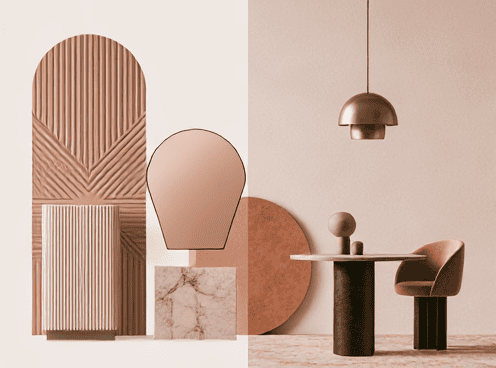
Searches for “antique bar cart” are up 100%. “Red marble bathroom,” up 80%. “Pendant lamp,” up 40%. Pinterest has named the whole thing Neo Deco and filed it as a defining 2026 trend — and Houzz, working from entirely separate data, predicts the same revival.
Two forecasters landing on the same conclusion is worth rather more than either one alone. So let’s take it as settled: Deco is coming back. The more useful question — the one nobody seems to answer — is what you’re supposed to do about it in a house you already live in, furnished with things you already bought.
Key takeaways
- Pinterest named Neo Deco a 2026 trend — “antique bar cart” +100%, “red marble bathroom” +80%, “pendant lamp” +40%
- Houzz independently forecasts the same return: chevron, brass, jewel tones
- Neo Deco is not period reproduction — it’s one Deco gesture in an otherwise restrained room
- The failure mode is the theme-park room. Three Deco moves is a scheme; ten is a film set
What is Neo Deco, exactly?
Art Deco proper is a specific historical style — geometric, symmetrical, luxurious in material, born around the 1925 Paris exposition that gave it its name and whose centenary has just passed. Chevrons, sunbursts, lacquer, brass, marble, velvet.
Neo Deco is the diluted, liveable version: the same vocabulary used sparingly inside an otherwise modern room. A fluted cabinet against plain walls. One scalloped mirror. A brass pendant over an ordinary table. The reference is legible without the room becoming a period set.
Deco was never actually about excess. It was about geometry taken seriously, and materials that behaved expensively. Both survive perfectly well in small doses.
Why is Art Deco coming back in 2026?
Two forces, running together.
The first is the calendar. The style’s centenary has renewed institutional interest — exhibitions, reissues, auction attention — and that kind of attention reliably filters down into what people search for and buy.
The second is fatigue. A decade of stark minimalism produced a great many rooms that were correct and unmemorable. Houzz frames the return explicitly as a pivot away from that: toward the opulent, the personal, the historically aware. Which is the same argument, in a different medium, as the one currently driving women back to heirloom jewellery.
THE GILT take: the beige decade taught a generation to decorate defensively — to choose the thing that couldn’t be criticised rather than the thing they actually wanted. If you’ve ever stood in a room that was perfectly nice and completely forgettable, that’s the instinct this is reacting against. Neo Deco is what happens when people stop apologising for wanting a room to be interesting.
What actually makes a room read Deco?
Five elements do nearly all the work. The third column is the line between considered and costume.
| Element | How to use it | Where it tips over |
|---|---|---|
| Brass or bronze | One finish, repeated — a lamp, a handle, a frame | Mixing brass, chrome and gold in the same room |
| Geometry (chevron, fan, sunburst) | In a single place: a mirror, a rug, a tile run | Chevron on the floor and the walls and the cushions |
| Marble | One surface, ideally veined and dark | Marble on every horizontal plane |
| Velvet or mohair | A single upholstered piece | A fully velvet room, which reads as a hotel bar |
| Curved or fluted forms | A cabinet, an arch, a chair back | Every edge rounded; the room loses structure entirely |
The pattern is one instance of each, not five. Deco is a high-contrast language, and contrast only works if there’s something quiet to contrast against. Used everywhere at once it stops being contrast and simply becomes wallpaper — expensive wallpaper, but wallpaper.
Where do you start if you own none of it?
In roughly this order, cheapest and most reversible first.
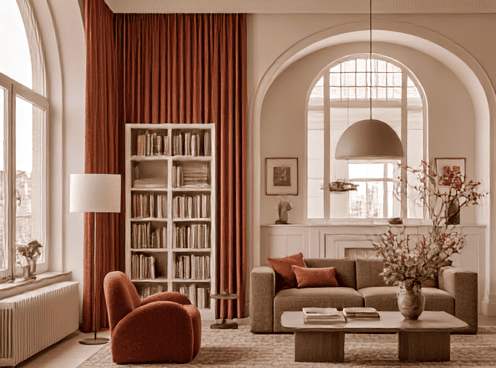
- Lighting. The single highest-impact swap in any room. A brass or opal-glass pendant changes a space more than furniture does, and costs a fraction.
- A mirror. Scalloped, arched or sunburst. It reads Deco instantly and takes no floor space.
- The bar cart. The trend’s emblem for a reason — it is a whole Deco gesture on wheels, and can leave the room when you tire of it.
- Textiles. One velvet cushion in a jewel tone. Emerald, ox-blood, ochre.
- Then, only if you still want it: a fluted or lacquered piece of furniture. This is the expensive, least reversible step. Do it last.
Shop a brass or opal-glass pendant → — the cheapest change with the largest effect.
Shop an arched or scalloped mirror → — reads Deco immediately, takes no floor space.
Shop a bar cart → — the trend’s emblem, and easy to move on from.
Does this work in a small or rented flat?
Better than most trends, actually. Neo Deco is carried by objects and finishes rather than architecture, and nearly everything on the list above is portable.
Renters get most of the way there with lighting, a mirror, one textile and one piece of furniture — no drilling, nothing structural, all of it leaves with you. The elements that do require commitment — tiling, panelling, a marble surround — are precisely the ones worth skipping until you own the walls.
The one caution specific to small rooms: dark, high-contrast schemes need light to read as luxurious rather than merely dim. If a room is already short of daylight, take the brass and the geometry and leave the jewel-toned walls.
The turn: the theme-park problem
Every revival style has a characteristic failure, and Deco’s is unusually easy to trigger: commit to all of it at once and the room stops looking designed and starts looking themed. Gatsby-adjacent. A cocktail bar that happens to contain a sofa.
It happens because Deco is internally consistent — the elements genuinely do go together, which makes over-application feel correct while you’re doing it. The brake has to be applied deliberately.
The workable rule is the same one that governs a brooch on a plain coat: ornament needs plain ground to read against. Three Deco moves in an otherwise restrained room is a scheme. Ten is a set. The restraint isn’t a compromise on the style — it’s the thing that lets anyone see it.
What colours actually belong to Neo Deco?
This is where most attempts drift, because the palette is narrower than people expect. Deco is not “any dark colour plus gold.” It runs on saturated jewel tones held against warm neutrals, and the neutrals are doing at least half the work.
| Colour | Use it for | Note |
|---|---|---|
| Emerald | One upholstered piece, or a single wall | The most forgiving jewel tone — reads rich rather than loud |
| Ox-blood / oxide red | Textiles, a lacquered surface, marble veining | The colour behind that 80% rise in red marble searches |
| Ochre and mustard | Cushions, a rug, ceramics | Warms a scheme fast; easy to overdo, so keep it small |
| Charcoal | Joinery, frames, grounding elements | Reads more expensive than black, which can flatten |
| Cream and bone | Walls, the majority of the room | The quiet ground everything else needs in order to register |
Notice the proportions implied there. Four of those are accents; one is most of the room. If you find yourself picking jewel tones for the walls and the sofa and the curtains, you’ve stopped decorating and started upholstering a jewellery box.
Should you buy Neo Deco secondhand?
Almost always, yes — and this is the part the trend coverage tends to skip.
Deco has been reproduced continuously for a century, which means the secondhand market is unusually deep and unusually good value. It also means the genuinely old pieces are heavier, oddly proportioned and made of materials that nobody would use at that price today. Exactly the qualities that make an object look inherited rather than bought this season.
What to look for
- Weight. The same tell as with jewellery. Reproduction Deco is light and hollow; the real thing has heft, and sits differently in a room.
- Real veneer, not printed. Look at the edges and the joins. Printed woodgrain gives itself away where two panels meet.
- Original brass, not brass-coloured. Genuine brass dulls unevenly and takes fingerprints. A perfectly uniform gold finish is almost always plating.
- Damage you can live with. Veneer chips and dulled metal are fine — desirable, even. Structural wobble and failed joints are not; repairs cost more than the piece.
The best hunting is the least glamorous: house-clearance sales, provincial auction houses, and the unfashionable end of any antiques centre. Deco lighting in particular turns up constantly and sells for a fraction of new reproductions, because it’s awkward to photograph and most people scroll past it.
Frequently asked questions
Is Art Deco actually trending in 2026?
Yes, and from two independent forecasts. Pinterest named Neo Deco a 2026 trend, reporting “antique bar cart” searches up 100%, “red marble bathroom” up 80% and “pendant lamp” up 40%. Houzz separately predicts an Art Deco return in 2026 home design.
What’s the difference between Art Deco and Neo Deco?
Art Deco is the historical style in full — period furniture, symmetry, lacquer, the complete vocabulary. Neo Deco borrows a few of its elements and places them inside an otherwise contemporary room. One is reproduction; the other is reference.
What’s the cheapest way to start?
Lighting. A brass or opal-glass pendant alters a room more than any other purchase at the price, and it’s reversible. A mirror is the next best move.
Can I do this in a rental?
Yes — the style travels in objects rather than architecture. Lighting, mirrors, textiles and one piece of furniture will carry it without a single hole in the wall.
How do I avoid it looking like a themed bar?
Limit yourself to roughly three Deco gestures per room and keep everything else plain. Ornament only reads when there is quiet around it.
Disclosure: This post contains affiliate links. If you buy through them, THE GILT may earn a commission at no extra cost to you. We only recommend products that meet our evidence and usefulness standards.
Leave a Reply